MOD002684 (Thermofluids) Assessment
Assignment Brief
Element 011: MOD002684 (Thermofluids) Assessment
QUESTIONS: Element 011: MOD002684 (Thermofluids) Assessment
Part A
A piston–cylinder device initially contains 0.A m3 (A is the digit in your SID ****ABC, if A is 0 or 1, then take the next higher digit between B or C) of air at 100 kPa and 80 °C. The air is then compressed to 0.1 m3 in such a way that PV = constant. Determine the work done during this process. (5 Marks)
Part B
The air enters the compressor at a temperature of 280 K with an enthalpy of 280.13 kJ/kg and is compressed steadily to 400 K with an enthalpy of 400.98 kJ/kg. The mass flow rate of the air is 0.0A kg/s (A is the digit in your SID ****ABC, if A is 0, then take the next higher digit between B or C) and a heat loss of 16 kJ/kg occurs during the process. Determine the necessary power input to the compressor when:
-
the changes in kinetic and potential energies are negligible. (7 Marks)
-
the air velocity at entry is 100 m/s and exit is 150 m/s but potential energy is negligible. (7 Marks)
Provide a reflective commentary underpinning the KEY conceptual elements in solving problem Q1 Part B (maximum 100words) (6 Marks)
Part A:
Heat is transferred to a heat engine from a furnace at a rate of 100 MW. If the rate of waste heat rejection to a nearby river is BC MW (BC are the digits in your SID ****ABC). Determine the net power output and the thermal efficiency for this heat engine. (8 Marks)
Part B
A heat source at 800 K loses 2000 kJ of heat to a sink at (a) 500 K and (b) ABC K (ABC are the digits in your SID ****ABC, for those who has SID number A = 0 or 1 or 2, replace A by 7) (shown in Figure Q2B). Determine which heat transfer process is more irreversible based on the entropy calculation. (11 Marks)
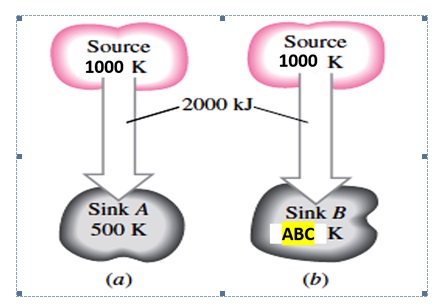
Figure Q2B
Provide a reflective commentary underpinning the KEY conceptual elements in solving problem Q1 Part B (maximum 100 words) (6 Marks)
An ideal Otto cycle has a compression ratio of 8. At the beginning of the compression process, air is at 100 kPa and 17°C, and ABC kJ/kg (ABC are the digits in your SID ****ABC, for those who has SID number A = 0 or 1 or 2, replace A by 7) of heat is transferred to air during the combustion process. Determine:
-
the pressure and temperature at the end of the compression process (8 Marks)
-
the thermal efficiency of the cycle (3 Marks)
-
the net output work of the cycle per kg of air (4 Marks)
-
the mean effective pressure for the cycle (4 Marks)
Assume Cv=0.718 kJ/kg.K and Cp=1.005 kJ/kg.K for air.
Provide a reflective commentary underpinning the KEY conceptual elements in solving this problem (maximum 100 words)(6 Marks)
A fuel with a chemical formula C8H1A (A is the digit in your SID ****ABC, if A is an odd number, choose the next even number) is burned with dry air. The volumetric analysis of the exhaust products gases on a dry basis are CO2: 10.02%, O2: 5.62%, CO: 0.88% and N2: 83.48%.
Determine
-
the air–fuel ratio (15 Marks)
-
the percentage of theoretical air used (4 Marks)
Provide a reflective commentary underpinning the KEY conceptual elements in solving this problem (maximum 100 words)(6 Marks)
Element 011: MOD002684 (Thermofluids) Assessment
Part A: Choose the correct option.
5A1. For the same compression ratio, the efficiency of diesel cycle is........Otto cycle (provide reason)
-
Greater than
-
Less than
-
Equal to
-
None of the above
(2 Marks)
5A2: Which of the following is true for a steady flow system? (provide reason)
-
mass entering = mass leaving
-
mass does not enter or leave the system
-
mass entering can be more or less than the mass leaving
-
none of the mentioned
(2 Marks)
Part B
A rigid tank contains BC kg (BC is the digit in your SID ****ABC) of water at 90°C. If 80% by mass of the water is in the liquid form and the rest is in the vapour form. Determine
- the pressure in the tank (2 Marks)
- the dryness fraction of the mixture (3 Marks)
- the total volume of the tank (3 Marks)
- the internal energy (U) (3 Marks)
- the enthalpy (H) (2 Marks)
- the entropy (S) (2 Marks)
Provide a reflective commentary underpinning the KEY conceptual elements in solving problem Q5 Part B (maximum 100 words) (6 Marks)
Element 011: MOD002684 (Thermofluids) Assessment
A certain gas of 2 kg is kept at BC (BC is the digit in your SID ****ABC) °C in a constant volume chamber of 0.3 m3 capacity. Heat is transferred to the gas until the temperature is of the gas reached to100 °C. The gas has cp = 1.968 kJ/kg-K and cv = 1.507 kJ/kg-K. Universal gas constant 8.314 kJ/kg-mol K. Determine:
- the molecular weight (3 Marks)
- the gas constant (2 Marks)
- the work done (3 Marks)
- the heat transferred (2 Marks)
- the change in internal energy (3 Marks)
- the change in enthalpy (3 Marks)
- the change in entropy (3 Marks)
Provide a reflective commentary underpinning the KEY conceptual elements in solving this problem (maximum 100 words) (6 Marks)

