Custom-Written, AI-Free & Plagiarism-Free Academic Work by Assignment Experts

Assignment Experts UK is a trading name of AKOSZ TEC LTD (Company No. 11483120). View on Companies House

Control Systems and Vibrations

Assignment Brief

Element 011: MOD005409 Assessment

Instructions to Students: Element 011: MOD005409 Assessment

  1. Answer All SIX questions

  2. The reflective parts for each question have 6 marks and limited to 50 words. This is about capturing concise/key conceptual understanding; exceeding word limit for this part will result in penalisation and your reflective writing will be marked out of 3

  3. The data for some questions must be taken from your SID. Not complying to the instructions provided in each question, will result in mark reductions.

  4. The deadline will be stated on the Canvas assignment page

  5. This work will be submitted to Turnitin

  6. Marks have been allocated individually to each question, adding to 100

Question 1: 

Elaborate and Draw the Bode diagram for the following transfer function shown in Figure.Q1 through:                                                                                             

(a)  Showing transfer function for separate parts,

                                                                                             (2 marks)

(b)  Drawing the Bode diagram for each part,

                                                                                             (3 marks)

(c)  Drawing the overall Bode diagram. 

                                                                                             (5 marks)                                 

 

 Figure.Q1  

Provide a reflective commentary underpinning the KEY conceptual elements in solving this problem (maximum 50 words, 6 Marks)

(Total 16 marks)                                                                                                                        

Question 2

(a) A system has a pair of complex conjugate poles p1 and p2 = -1+j2 and -1-j2 respectively and a single real zero z1 = -4 and a gain factor k = 3. Explain how to find the differential equation representing the system.

                                                                                                (5 marks)

(b) Explain and Identify the common terms in transient response characteristics of control system and specify the accepted limits in each transient response        

                                                                                                            (3 marks)

c) Explain by drawing the concepts of different types of damping types in relation to the natural angular velocity.

                                                                                                            (3 marks)

Provide a reflective commentary underpinning the KEY conceptual elements in solving this problem (maximum 50 words, 6 Marks)

                                                                                      (Total Question Mark: 17)

Question 3

Discuss how you calculate the following step response and complete the table next to it according to the measurement results as shown on each axis:
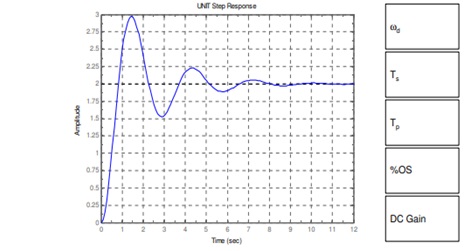
 

                                                                                                (9 marks)

Provide a reflective commentary underpinning the KEY conceptual elements in solving this problem (maximum 50 words, 6 Marks) (Total 16 marks)                                                                                                                      

Question 4

  1. 1.    A mass m is held up by a force F0 sin(Ѡt) and connected to a spring and a damping coefficient c with the ground. The following parameters are known: the mass m = 100kg, the spring stiffness k = 700x103 N/m, the peak force F0 = 350 N. If the revolution speed is 300 RPM and the damping ratio is 0.2, find the followings:

           (a) Displacement amplitude X                                                (6 marks)

           (b) Transmissibility ratio TR = FT/F0                                                          (4 marks)

             (c) Magnitude of transmitted force FT                                     (4 marks)

Provide a reflective commentary underpinning the KEY conceptual elements in solving this problem (maximum 50 words, 6 Marks)

                                                                                                      (Total 20 marks)

Question 5

A top-loading washing machine executes the spin cycle at 4 rotations per second. The mass of the drum is 10 kg and it has a diameter of 0.6 m. The stiffness and damping coefficient of the mount are 379 N/m and 37.7 N.s/m respectively. If the mass of clothes is 5 kg. If the clothes are in the same place in one side of the drum, calculate:       

      (a) The damping frequency and the natural frequency                              (3 marks)

      (b) the damping ratio                                                                                 (3 marks)

      (c) Vibration amplitude                                                                              (3 marks)

       (d) Transmitted force                                                                                 (3 marks)  

Provide a reflective commentary underpinning the KEY conceptual elements in solving this problem (maximum 50 words, 6 Marks)             

                                                                                                              (Total 18 marks)

Question 6

(a) A 160-gram object attaches at one end of a spring and the change in length of the spring is 4 cm. What is the change in length of three springs connected in series and parallel, as shown in the figure below if the three springs have the same constant, k = 40 N/m. Take the gravity acceleration as 10 m/s2.
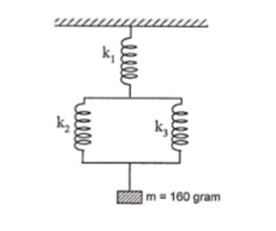
 (6 marks)                           

Provide a reflective commentary underpinning the KEY conceptual elements in solving this problem (maximum 50 words, 6 Marks) (Total 13 marks)

End of Questions: 

100% Plagiarism Free & Custom Written,
tailored to your instructions

Sample Answer

Control Systems and Vibrations

Question 1: Bode Diagram Analysis

(a) Transfer Function Decomposition
The given transfer function can be expressed as a product of its constituent parts:

G(s) = K × (s + z1)(s + z2)... / (s + p1)(s + p2)...

Each zero and pole contributes individually to the magnitude and phase plot in a Bode diagram. Decomposing the transfer function allows separate analysis of first-order and second-order components.

(b) Bode Diagram for Each Part

  • First-order pole: magnitude slope −20 dB/decade, phase shifts from 0° to −90° around the pole frequency.

  • First-order zero: magnitude slope +20 dB/decade, phase shifts from 0° to +90° around the zero frequency.

  • Second-order poles or zeros: produce resonant peaks or sharper slope changes depending on damping ratio.

(c) Overall Bode Diagram
The total Bode diagram is obtained by summing the magnitudes (in dB) and phases of individual components across all frequencies. Key breakpoints occur at pole and zero frequencies, where slope changes accumulate.

Reflective Commentary (50 words max):
Breaking down the transfer function simplifies frequency response analysis. Bode diagrams help visualise magnitude and phase behaviour, enabling engineers to predict stability and design compensators.

Question 2: Differential Equation and Transient Response

(a) Differential Equation Formation
Given poles p1 = −1 + j2 and p2 = −1 − j2, zero z1 = −4, and gain k = 3:

  1. Characteristic polynomial from poles: s^2 + 2s + 5

  2. Include zero: (s + 4)

  3. Transfer function: G(s) = 3 × (s + 4) / (s^2 + 2s + 5)

  4. Time-domain differential equation:

y``(t) + 2y`(t) + 5y(t) = 3 x`(t) + 12 x(t)

(b) Transient Response Characteristics

  • Rise time (tr): time to reach 90% of final value

  • Peak time (tp): time to first maximum

  • Overshoot (Mp): maximum deviation from steady-state

  • Settling time (ts): time to remain within ±2% of final value

(c) Damping Types

  • Underdamped (ζ < 1): oscillatory response

  • Critically damped (ζ = 1): fastest non-oscillatory response

  • Overdamped (ζ > 1): slower non-oscillatory response

Reflective Commentary (50 words max):
Poles and zeros determine system response. Transient response parameters provide insight into stability and performance. Damping type affects overshoot and settling, critical for control system design.

A Bode diagram represents a system’s frequency response using magnitude and phase plots, helping engineers assess stability and design controllers effectively.

Displacement amplitude can be calculated using the mass, spring stiffness, damping ratio, and applied force, often with the formula X = F0 / √((k - mω²)² + (cω)²).

Descriptive statistics summarise data (e.g., mean, standard deviation), while inferential statistics predict or estimate system behavior based on sample data.

The damping ratio defines how oscillations decay over time, affecting stability, vibration amplitude, and system performance.

George

I struggled with damping ratios and transmissibility before, but this guide explained formulas step-by-step.

United Kingdom

★★★★★
Jackson

Spring-mass system questions were simplified with clear examples, making the calculations straightforward.

United Kingdom

★★★★★
Hazel

Step response and dynamic analysis were thoroughly explained. Very useful for understanding control systems practically.

United Kingdom

★★★★★
Avery

The reflective parts helped me understand the concepts without going overboard. Concise and precise guidance.

United Kingdom

★★★★★
